
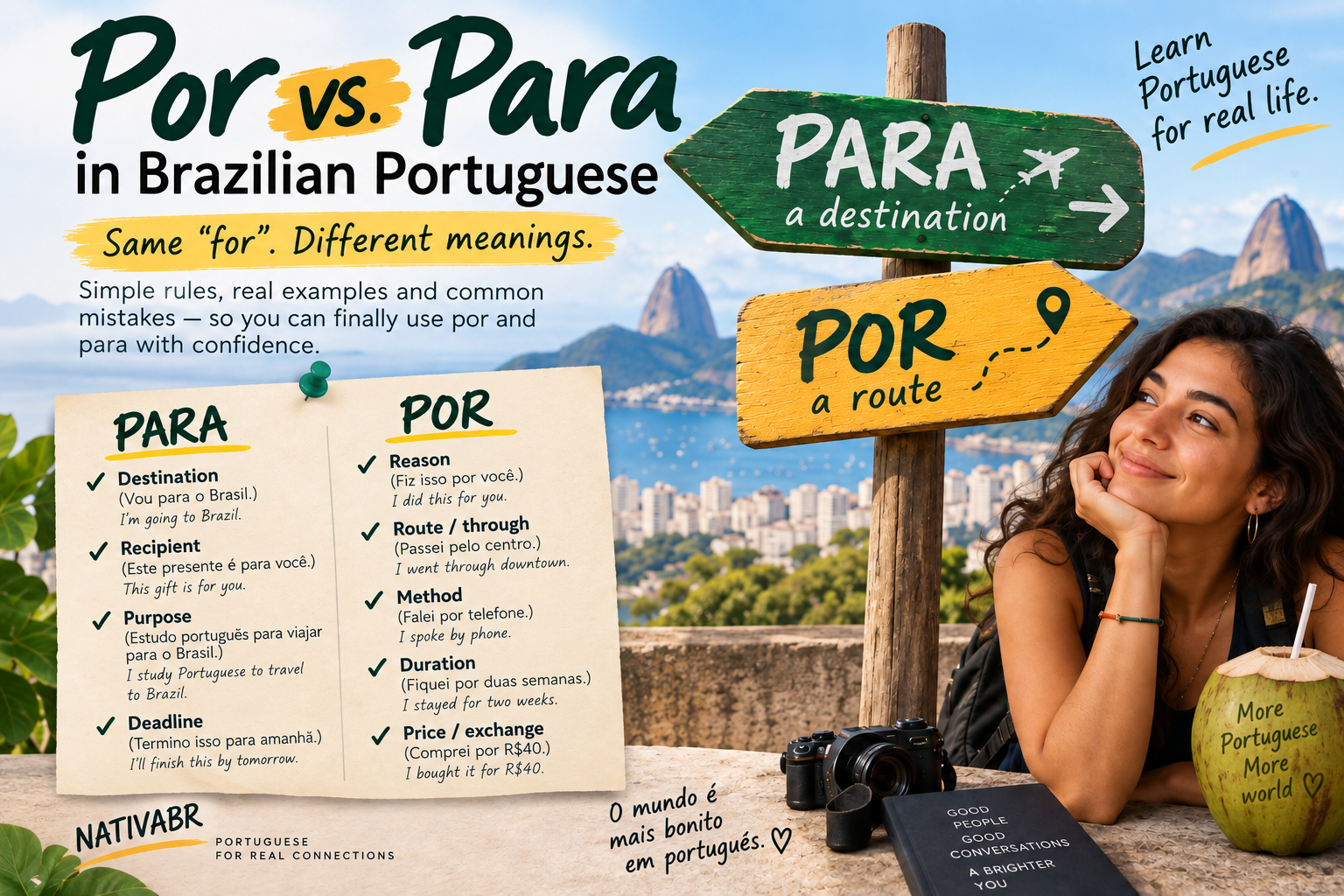
If por and para both seem to mean “for,” you’re not imagining things.
Compare these sentences:
English uses for in both sentences. Portuguese doesn’t.
That is exactly why por vs. para can be confusing for Portuguese learners.
The good news is that you don’t need to memorize dozens of disconnected rules.
A useful starting point is:
PARA usually points toward a destination, recipient, purpose, or deadline. POR usually explains a reason, route, method, duration, or exchange.
This won’t explain every possible use of these prepositions, but it will help you understand most of the situations you’ll come across as a learner.
Now let’s see how Brazilians actually use them.
PARAWhen do we use PARA?
Think of para as pointing toward something.
That something could be a place, a person, a goal, or a future point in time.
1. Destination: where are you going?
Use para when someone or something is moving toward a destination.
A useful question is:
Where to? → PARA
2. Recipient: who is it for?
Use para when something is intended for someone.
Here, para points toward the person receiving something.
3. Purpose or goal: what is the goal?
Use para to talk about the purpose of an action.
Notice something important.
When para expresses purpose and is followed by a verb, Portuguese normally uses the infinitive:
para viajar
para comprar
para aprender
A useful question is:
For what purpose? → PARA
4. Deadline or intended time
Para can also point toward a future deadline or intended time.
Again, there is a sense of moving toward a future point.
PORWhen do we use POR?
Now think about por differently.
POR often tells us why something happens, how it happens, the route it takes, how long it lasts, or what is exchanged.
1. Reason or cause: why?
Use por when explaining the reason behind something.
That last sentence contains something you will see constantly in Portuguese:
pela = por + a
So:
por + o = pelo
por + a = pela
por + os = pelos
por + as = pelas
That’s why we say:
and:
2. Movement through or around a place
Use por when you pass through, by, or around somewhere rather than moving toward it as your destination.
Compare:
The center is my destination.
But:
Now the center is part of the route.
Another example:
The beach is the area where the movement happened.
A useful distinction is:
Para vs. Por: one small change, a different meaning
Look at this pair:
São Paulo was the destination.
São Paulo was part of the route.
That small preposition completely changes what happened.
3. Method or means: how?
Por can describe the means or method used to do something.
Again:
pela = por + a
One useful detail: with transportation, Brazilian Portuguese normally uses de, not por.
So don’t try to use por for every English expression containing “by.”
4. Duration: for how long?
When talking about a period of time, por is often used.
But here is some real Brazilian Portuguese.
In everyday speech, Brazilians often omit por in sentences like these.
You may hear:
Fiquei duas semanas no Rio.
instead of:
Fiquei no Rio por duas semanas.
Both can sound completely natural.
This is a good example of the difference between understanding grammar and understanding how people actually speak.
5. Price or exchange
Use por when something is exchanged for something else, especially money.
6. Frequency: per day, per week, per month
You will also hear por constantly when talking about frequency.
Expressions such as por dia, por semana, por mês, and por pessoa are extremely common in everyday Portuguese.
The easiest way to remember Por vs. Para
Instead of translating everything into English, ask yourself what relationship the preposition is expressing.
| Think about... | Use |
|---|---|
| Destination | para |
| Recipient | para |
| Purpose / goal | para |
| Deadline / intended time | para |
| Reason / cause | por |
| Route / movement through | por |
| Method / means | por |
| Duration | por |
| Price / exchange | por |
| Frequency | por |
The most important advice is this:
Don’t ask: “Does this mean FOR?”
Ask:
“What relationship am I expressing?”
That will help you much more.
But Brazilians keep saying PRA. What is that?
Now we get to the Portuguese you will actually hear in Brazil.
In everyday Brazilian Portuguese, para very often becomes:
pra
So instead of:
Isso é para você.
you will very often hear:
Instead of:
Vou para casa.
you may hear:
Instead of:
Estou estudando para aprender português.
you might hear:
The meaning has not changed.
Pra is simply a very common reduced form of para in informal Brazilian Portuguese.
What about pro, pros and pras?
Brazilians also commonly reduce para when it appears with articles.
para o → pro
para os → pros
para a → pra
para as → pras
For example:
Vou para o mercado.
→ Vou pro mercado.
Vou para a praia.
→ Vou pra praia.
Comprei presentes para os meus amigos.
→ Comprei presentes pros meus amigos.
You will hear forms like these all the time in Brazil.
For learners, the important thing is to recognize both versions.
In formal writing, para is usually the safer choice. In conversation, messages, social media, and other informal contexts, forms such as pra, pro, pros, and pras are extremely common.
Common Por vs. Para mistakes
Here are a few mistakes English speakers often make.
❌ Obrigado para a ajuda.
✅ Obrigado pela ajuda.
Why?
Portuguese uses por with the thing you are thanking someone for:
por + a ajuda → pela ajuda
❌ Eu estudo português por viajar ao Brasil.
✅ Eu estudo português para viajar para o Brasil.
Traveling to Brazil is the purpose of studying Portuguese.
Purpose → para
❌ Eu vou por Brasil amanhã.
✅ Eu vou para o Brasil amanhã.
Brazil is the destination.
Destination → para
But compare:
✅ Eu vou passar pelo Brasil.
I’m going to pass through Brazil.
Now Brazil is part of the route, so por makes sense.
❌ Este presente é por você.
If you mean the person receiving the gift:
✅ Este presente é para você.
This gift is for you.
But:
✅ Fiz isso por você.
I did this for you.
Why the difference?
With the gift, you are the recipient, so we use para você.
With Fiz isso por você, you are the reason or motivation behind the action, so we use por você.
This is one of the best examples of why translating word for word doesn’t work.
Para você vs. Por você
This contrast deserves extra attention.
You are the recipient.
You are the reason or motivation.
Compare:
with:
Same English word.
Different relationship.
Different Portuguese preposition.
A real Brazilian conversation
Here’s what these words can sound like in everyday Brazilian Portuguese:
Brazilian Portuguese in real life 🇧🇷
Você vai pra praia amanhã?Are you going to the beach tomorrow?
Vou. Vou encontrar uns amigos lá.Yeah. I’m going to meet some friends there.
Vai de carro?Are you going by car?
Não, vou de ônibus. Acho que vou passar pelo centro.No, I’m taking the bus. I think I’m going through downtown.
Vai ficar lá quanto tempo?How long are you going to stay there?
Só umas horas. Tenho que voltar pra casa cedo.Just a few hours. I have to get home early.
Notice how naturally pra, pelo, and por appear in everyday speech.
Also notice umas horas and tenho que. These are completely normal choices in spoken Brazilian Portuguese.
The goal is not only to know the rule. You also want to recognize these structures when Brazilians actually speak.
One final trick
When you're not sure which one to use, ask yourself:
Am I pointing toward something?
A destination?
A recipient?
A purpose?
A deadline?
→ Think PARA.
Or am I talking about the reason, route, method, duration, or exchange connected to the action?
→ Think POR.
This won’t replace learning through real examples, but it is a much better starting point than translating the English word for every time.
Mini Quiz: Por or Para?
Try these before checking the answers.
Answers
You are the recipient.
It describes duration.
Speaking with the family is the goal.
por + a mensagem = pela mensagem
Copacabana is part of the route.
R$40 is the price.
Keep learning Brazilian Portuguese
The more you hear por and para in real conversations, the easier this difference becomes.
Start with the patterns above, pay attention to how Brazilians use them, and don’t worry about getting every example right immediately.
Want to keep practicing? Explore more Brazilian Portuguese lessons from NativaBR. 🇧🇷